


Governance Defined: From Historical Roots to Modern Frameworks
 By
By 
The first step in our journey through the Governance Universe—exploring the word’s origins and the frameworks that shape how organizations are led today.
Introduction
So, what exactly is governance?
To answer this question meaningfully, it helps to begin at the beginning—by tracing the word to its etymological roots. Understanding where the term comes from offers insight into the historical contexts, priorities, and power dynamics that shaped its meaning. From ancient seafaring metaphors to the centralized authority of monarchies, the evolution of the term reflects the evolution of how societies organize, direct, and hold power.
In this first article, we’ll explore the origins of the word governance, then move on to examine how leading institutions define it today. Finally, in true SG fashion, we’ll curate a personalized visual synthesis of the key governance themes and priorities echoed across these definitions—a conceptual map of what governance represents in today’s world.
1. The Origins of the Word “Governance”
The term governance stems from the Latin gubernare, meaning “to direct, rule, or guide.” This itself is a borrowing from the Ancient Greek kybernan (κυβερνᾶν), which meant “to steer or pilot a ship”—a metaphor that still resonates today in how we speak of “steering” organizations or “navigating” crises. ¹
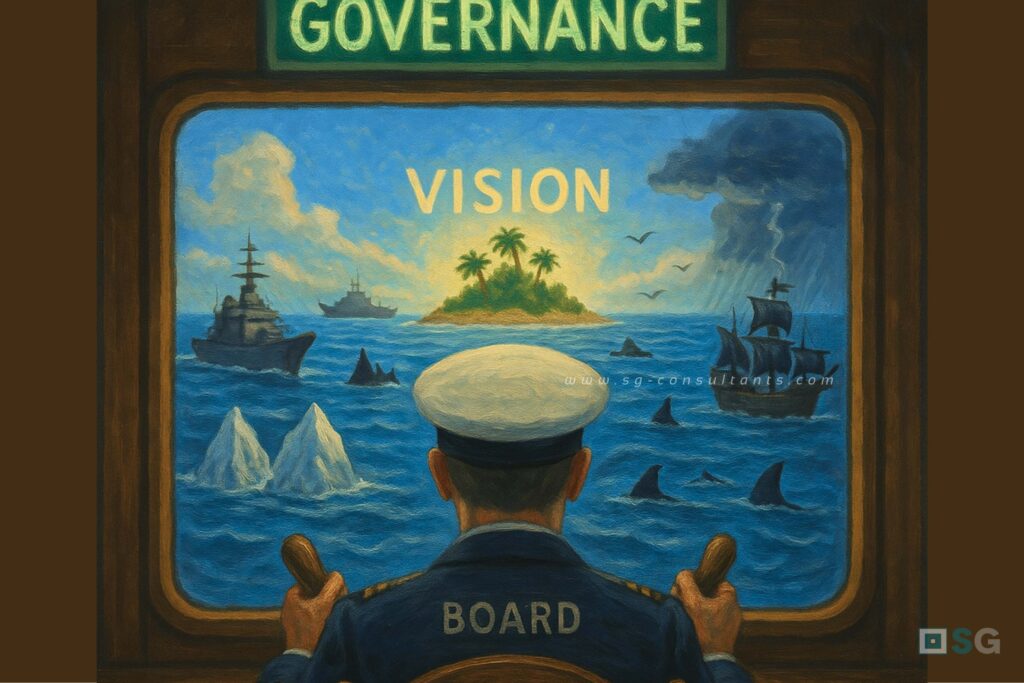
By the 14th century, the Old French word gouvernance had come to signify the act of ruling or administering, particularly in the context of state power. It was during this period in France—an era marked by dynastic struggles, war, and reform—that the concept of governance began to crystallize in political thought; through the reign of monarchs like John II “the Good”, Charles V “the Wise”, Charles VI “the Mad”, Charles VII “the Victorious”, and Louis XI “the Spider” between 1350 and 1483.
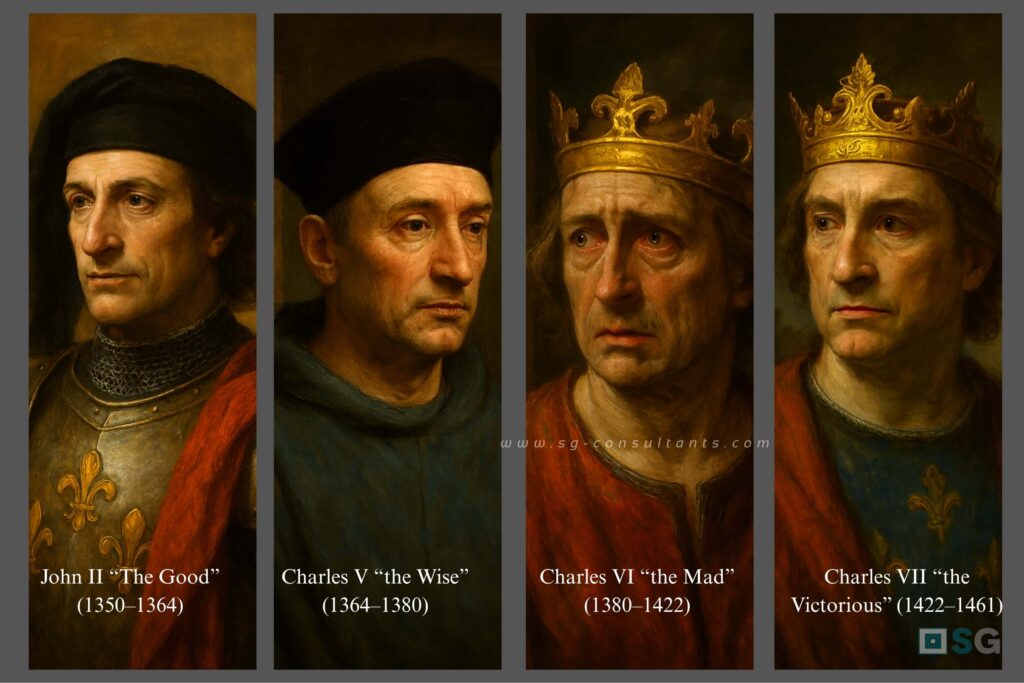
These rulers governed during the Hundred Years’ War, a time of intense political fragmentation and eventual centralization. Their reigns were defined by military campaigns, diplomatic manoeuvring, and administrative reforms that laid the groundwork for the modern French state.² In this historical context, governance referred to the sovereign authority to administer, rule, and guide the affairs of the state—much like a captain steering a ship through turbulent waters.
From Kingdoms to Corporations… today, the metaphor still holds. In the corporate world, governance is the responsibility of the “organes de gestion”—the governing bodies that steer an organization toward its mission and strategic objectives. Just as medieval monarchs were expected to rule wisely and justly, modern boards and executives are expected to lead with integrity, foresight, and accountability. Understanding this lineage helps us appreciate that governance is not just a modern management concept, but a centuries-old practice of leadership, direction, and stewardship.
2. Established definitions Governance.
Beyond monarchical conquests and down to the modern times of global trade and technology-driven enterprise, to understand what governance (corporate governance) means today, we will refer to the definitions from established bodies of knowledge, and institutions that lead thought and set the standards for best practices in corporate governance. By highlighting the key priorities of each reference, we will be able to curate our own synthetic definition of what Governance is.
► The Organization for Economic Cooperation and Development (OECD) in its G20 Principles of Corporate Governance (2015) describes Governance as involving ‘a set of relationships between a company’s management, its board, its shareholders and other stakeholders. Corporate governance also provides the structure through which the objectives of the company are set, and the means of attaining those objectives and monitoring performance are determined.’³ The OECD proposes a set of universal principles that are supposed to guide corporations towards more credible (corporate) governance arrangements that are conformant with the legal, regulatory and institutional frameworks within which they operate, and – par ricochet – boost investor confidence and facilitate access to ‘patient’ capital. The OECD however cautions that ‘there is no single model of good corporate governance’, and the principles have to be applied taking ‘into account into account country-specific economic, legal, and cultural differences.’
Key words: management, the board, shareholders, stakeholders, means, objectives, monitoring performance.
——————————————
►The Cadburry Report of 1992 is another authoritative guidance, but one that dwells more extensively on the ‘Financial Aspects of Corporate Governance’. The Cadburry 1992 report summarily describes Governance as ‘the system by which companies are directed and controlled.’⁴ In its introductory paragraph, it emphasizes the responsibilities of the key actors of Governance. The Board carries overall responsibility for governance of the company (within the limits of the law, regulation and decisions of the shareholder’s general meeting); it sets the ‘strategic aims’, provides leadership to put these aims into effect, supervises the management of the business and reports to shareholders on their stewardship. Shareholders on their part, appoint directors and auditors, to satisfy themselves that an appropriate governance structure is in place.

The report emphasizes Board responsibilities for financial policy, financial controls and financial reporting, and the role of auditors in providing an external, independent and objective check on the on the directors’ financial statements.
Key words: direction, leadership, control, board, shareholders, directors, auditors, strategic aims, management, reporting, stewardship, structure, financial policy, financial controls, financial reporting, financial statements, objective check.
——————————————
►ISO 37000, an international standard from the International Organization for Standardization, introduces ‘purpose’ as the driving force of organizations and places it at the core of its suggested Governance framework. It defines Governance as the ‘human-based system by which an organization is directed, overseen and held accountable for achieving its defined purpose.’⁵ According to ISO 37000, good Governance lays the foundation for the fulfilment of an organization’s purpose, through enhanced effective performance, responsible stewardship and ethical behaviour. Just like the G20 OECD 2015 Report, ISO 37000 is also principles based; providing four foundational principles and 6 enabling principles that make for layered/incremental improvements on the path to the desired governance outcomes.
Key words: purpose, human-based system, direction, oversight, accountability, effective performance, responsible stewardship, ethical behaviour.
——————————————
►The King IV Report (2016) is the fourth iteration on the King Reports on Corporate Governance, and was borne from an attempt to adapt existing notions of governance to the global realities…challenges of the ‘changed world’: inequality, globalised trade, social tensions, climate change, population growth, ecological overshoot, geopolitical tensions, radical transparency (thanks to ubiquitous social media) and rapid technological and scientific advancement. It sets the principles and standards for Corporate Governance in South Africa, and has gained global recognition due to its robustness and comprehensiveness.
The King IV Report defines Governance as ‘the exercise of ethical and effective leadership by the governing body towards the achievement of the following governance outcomes: ethical culture, good performance, effective control and legitimacy.’⁶
According to King IV, the governing body’s (primary) responsibility for governance includes: steering the organization in the right (strategic) direction, approving policy and planning that give effect to strategy and direction, overseeing and monitoring management, and ensuring accountability; all in a triple context – economy, society and environment.
Key words: changed world, ethical leadership, effective leadership, governing body, ethical culture, good performance, effective control, legitimacy, triple context.
——————————————
►COBIT 2019 speaks to the concerns of the era of digital transformation, concerns which can no longer be delegated or simply ignored by the Board of Directors and Management. According to COBIT 2019, Governance is the responsibility of the governing body to ‘ensure(s) that stakeholder needs, conditions and options are evaluated to determine balanced, agreed-on enterprise objectives to be achieved; setting direction through prioritization and decision making; and monitoring performance and compliance against agreed-on direction and objectives.’⁷

COBIT 2019 draws a clear distinction between Governance from Management: While governance sets direction and monitors outcomes, management—under the leadership of the CEO—plans, builds, runs, and monitors activities in alignment with that direction.
In a global economy driven by rapid technological advancement (digitization, artificial intelligence, the internet of things, block chain and robotics to name a few), information & technology (I&T) ‘have become crucial in the support, sustainability and growth of enterprises.’ This central position of I&T to stakeholder value creation called for a specific focus on Enterprise Governance of Information and Technology (EGIT), a core focus of COBIT 2019.
Key words: digital transformation, stakeholder needs, conditions, options, evaluation, balance, enterprise objectives, direction, prioritization, decision making, performance monitoring, compliance, management
——————————————
►The OHADA Framework stems from the OHADA treaty (Signed in 1993 and revised in 2008) which aims at harmonizing business law amongst member states (17 at the time of writing this article). It seeks to bolster governance practices by creating a stable legal and regulatory environment for business and investments in Africa. While the OHADA Framework does not explicitly define governance – neither in the treaty nor in the uniform acts related to general commercial law, commercial companies and economic interest groups) it does provide guidelines…requirements for the structuring of corporate leadership and relationship between ownership, the board and management of different company types (e.g. partnerships, LLCs, PLCs, joint ventures).
Livre 4 for example, recommends a clear separation between ownership (represented by a general assembly) and the board/management of PLCs, and mandates the appointment of an external auditor following a set of conditions (hallmarks of Cadbury and ISO 37000).⁸
As we unfold our quest of the governance universe, we will make it a point to highlight similarities and parallels between OHADA and other international frameworks.
3. Putting it all into perspective!
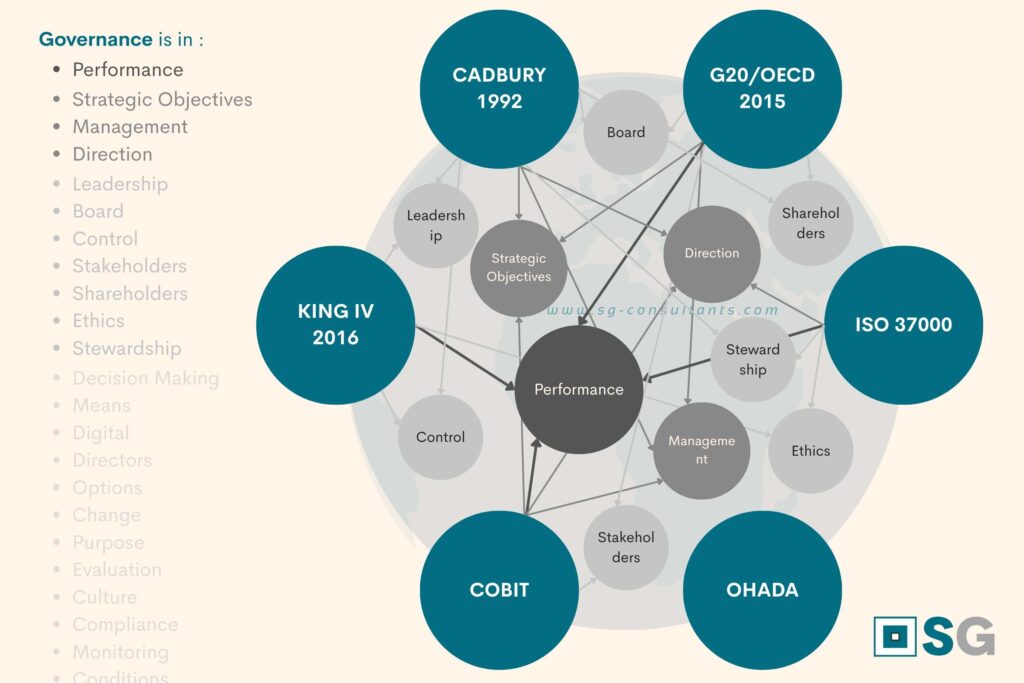
In true SG fashion, we’ve curated a visual synthesis that captures the recurring themes of governance across the frameworks we reviewed. Looking at the bubble visual, one theme stands out clearly: performance. And rightly so—governance exists to create an environment that enables the achievement of strategic goals. A culture of performance, once established, builds momentum and paves the way toward those goals.
Close behind are themes like direction, strategic objectives, and management. Just as a ship needs a captain to chart the course, the board must provide visionary direction, while management aligns the sails to navigate toward shared objectives. Other strong and consistent themes include leadership, the board, shareholders, stakeholders, stewardship, ethics, and control—each playing a vital role in shaping what governance looks like in practice.
With all that’s been said, we now turn the question to you: How would you define governance?
References
¹ Online Etymology Dictionary – Governance. Retrieved from: https://www.etymonline.com/word/governance
² Murphy, Neil (2018). The French Monarchy.The French Monarchy, Neil Murphy, 2018
³ OECD (2015). G20/OECD Principles of Corporate Governance, Section: About the Principles.
⁴ The Cadbury Report (1992). Report of the Committee on the Financial Aspects of Corporate Governance, Introduction: Corporate Governance.
⁵ ISO (2021). ISO 37000: Governance of Organizations — Guidance. Section 3: Terms and Definitions
⁶ Institute of Directors in Southern Africa (2016). King IV Report on Corporate Governance, Section: Fundamental Concepts – Definition of Governance.
⁷ ISACA (2019). COBIT 2019 Framework: Introduction and Methodology, Section 1.3.
⁸ OHADA (2008). Acte Uniforme Révisé Relatif au Droit des Sociétés Commerciales et du Groupement d’Intérêt Économique, Livre 4.

Comments (2)
Excellent synthesis of governance’s historical and institutional foundations.
One nuance increasingly missed in governance discussions is that while governance principles are public domain, governance methods are not automatically so. A staged, documented decision-making method can be independently authored, fixed in material form, publicly evidenced, and protected under copyright as method-origin IP — rather than assumed “method-free.”
As scrutiny increases (audit, regulation, media), the question is shifting from what governance is to how decisions were governed and where the governing method came from.
For context, I’ve published a short public information page explaining this distinction from a custodial perspective (general information only):
https://powergrouppurchasing.com
Thank you Chris.
You rightfully put it. Governance (methods, principles and practices) aren’t set in stone. Whilst we reference ‘popular’ frameworks, governance choices and decision making are influenced by a more complex equation of factors and determinants.
Culture and history are some of those things that come to mind.
Would be nice to engage further on this thought.